

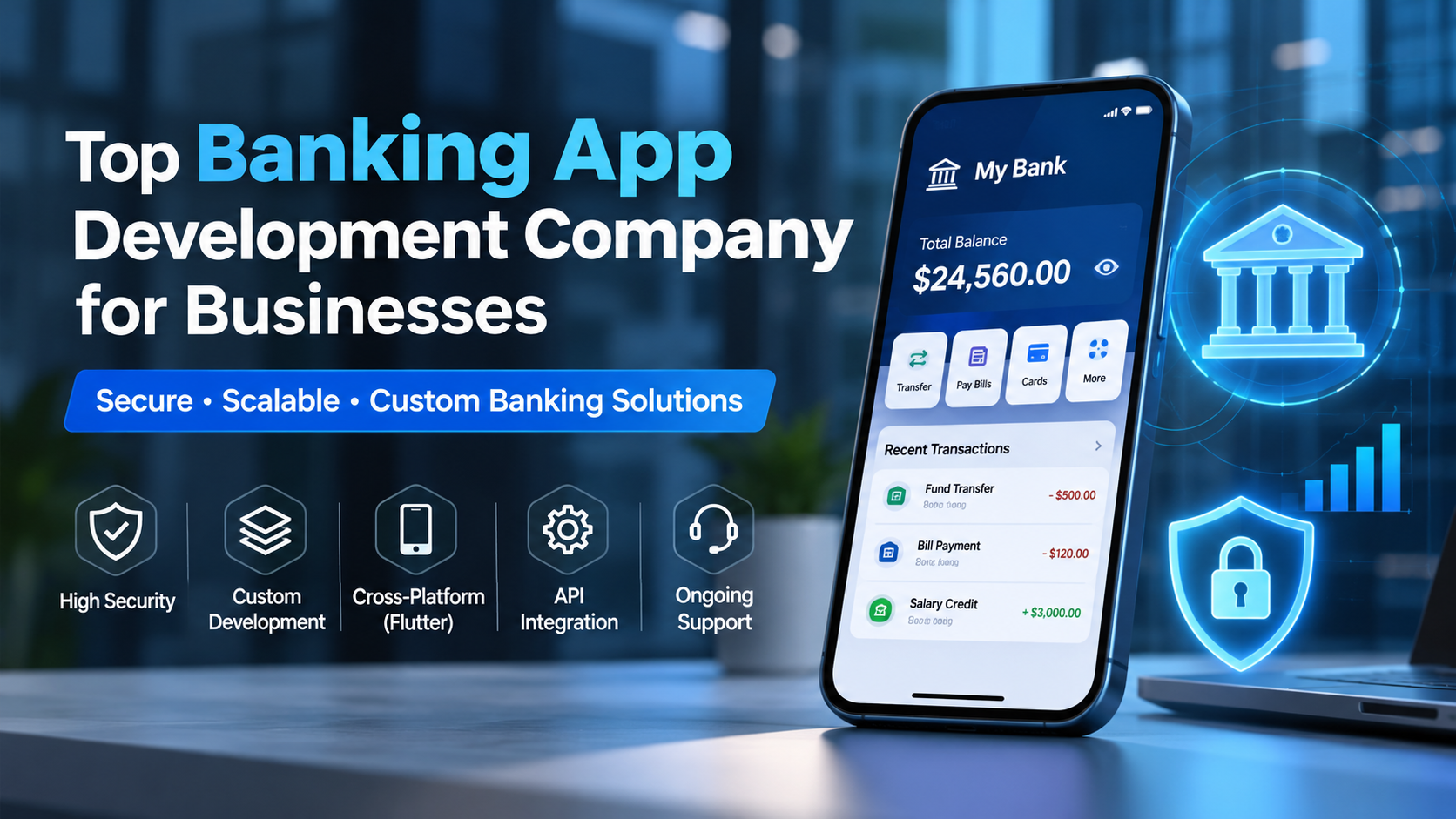
The financial services industry is evolving rapidly as businesses adopt digital banking solutions to improve customer experiences, streamline transactions, and expand their financial services. From traditional financial institutions to emerging fintech startups, organizations increasingly depend on mobile applications to provide convenient, secure, and accessible banking services.
Choosing the right banking app development company is a critical decision for businesses planning to launch or modernize digital financial products. A professional development partner helps transform complex banking requirements into functional mobile applications with intuitive interfaces, secure backend architecture, and reliable third-party integrations.
At Prenero Solutions, we specialize in custom web and mobile application development, UI/UX design, and API integration. We help businesses plan and develop digital solutions tailored to their operational requirements, customer expectations, and long-term growth objectives.
Whether you are a fintech entrepreneur exploring a digital wallet, an enterprise developing financial management software, or a financial institution planning a mobile banking application, understanding the development process is essential.
In this guide, we explore banking app development services, essential features, security considerations, technology stacks, development costs, and strategies for building modern financial applications.
What Is Banking App Development?
Banking app development is the process of designing, building, testing, and maintaining mobile or web applications that enable customers to access banking and financial services digitally.
A modern banking application allows users to perform financial activities without visiting a physical bank branch. Depending on the institution and available integrations, these activities may include checking account balances, transferring funds, paying bills, managing cards, reviewing transaction histories, and receiving financial notifications.
A professional mobile banking app development company typically works across multiple technical components, including frontend interfaces, backend services, databases, authentication systems, payment integrations, and administrative dashboards.
Unlike conventional mobile applications, banking software must meet demanding requirements for transaction integrity, data protection, system availability, and regulatory compliance.
Types of Banking Applications Businesses Can Develop
Retail Banking Applications
Retail banking applications provide individual customers with access to personal accounts, payments, transaction histories, and everyday banking services.
Corporate Banking Applications
Corporate banking platforms support business accounts, payment approvals, financial reporting, transaction management, and role-based access for organizational users.
Digital Banking Applications
Digital banking applications deliver financial services through online and mobile channels, sometimes without traditional physical branches. Their operation generally depends on appropriate banking licenses or regulated financial partnerships.
Fintech Applications
Fintech platforms provide specialized financial functionality such as digital payments, lending workflows, personal finance management, and investment-related services.
Digital Wallet Applications
Digital wallets allow users to manage supported payment methods, initiate transactions, and access electronic payment services through authorized providers.
Financial Management Applications
Financial management platforms help individuals and businesses track expenses, analyze transactions, prepare budgets, and monitor financial performance.
Each application category requires a development approach suited to its business model, user expectations, and financial infrastructure.
Why Businesses Need Professional Banking App Development Services
Investing in professional banking app development services helps organizations build financial applications that are easier to maintain, extend, and integrate with other systems.
1. Improved Customer Convenience
Customers expect financial services to be accessible whenever they need them.
Mobile banking applications provide convenient access to account information, financial transactions, notifications, and customer support.
By offering streamlined digital workflows, businesses can reduce unnecessary customer effort and improve the overall banking experience.
2. Stronger Financial Data Protection
Banking applications process sensitive personal and financial information.
We recommend integrating security requirements into the initial system architecture, including encrypted communication, secure authentication, backend authorization, and appropriate audit logging.
These controls help reduce exposure to unauthorized access, data leakage, and transaction manipulation.
3. Greater Operational Efficiency
Digital banking solutions can automate repetitive processes such as account inquiries, statement generation, payment notifications, and selected customer service activities.
Automation can reduce administrative workload while allowing employees to focus on more complex financial operations and customer relationships.
4. Scalable Business Growth
As businesses expand, their applications must accommodate additional users, transactions, services, and external integrations.
A well-structured banking platform can support modular enhancements without requiring a complete redesign whenever new financial products are introduced.
5. Competitive Digital Experiences
A banking application is often a primary customer interaction channel.
An intuitive interface, reliable performance, and clear transaction workflows can help financial organizations deliver a more competitive digital experience.
Comprehensive Banking App Development Services
At Prenero Solutions, our software development capabilities provide a foundation for custom financial application projects. The appropriate solution depends on the required features, financial service providers, and regulatory responsibilities.
Custom Banking Mobile App Development
Custom banking applications allow businesses to build features around their specific financial products and customer workflows.
Rather than relying entirely on generic software, organizations can define account management screens, payment interfaces, notification systems, and customer service functionality according to their requirements.
We develop custom mobile applications using technologies such as Flutter, supported by backend APIs and database-driven services.
Our development approach emphasizes maintainable code, structured interfaces, and clear separation between application presentation and sensitive backend operations.
Fintech App Development
Fintech applications combine financial services with modern software technologies.
We help businesses structure financial technology projects involving payment interfaces, digital wallets, transaction dashboards, financial reporting, and connected backend services.
Depending on the product, development may require integration with regulated payment processors, banking-as-a-service providers, identity verification services, or other authorized financial platforms.
Digital Banking Platform Development
A digital banking platform typically consists of interconnected application components.
These may include customer-facing mobile applications, web portals, administrative dashboards, authentication services, financial integrations, and reporting systems.
We recommend modular architectures that allow individual components to evolve while maintaining consistent data access and security controls.
Banking API Development and Integration
API integration is fundamental to modern financial applications.
Secure APIs allow banking applications to communicate with approved third-party systems and internal services.
Common integrations include payment processing, account information services, identity verification, notifications, and customer management systems.
Our web and mobile development services include custom backend and API development capabilities that can support connected software platforms.
Banking App UI/UX Design
Financial applications must make complex transactions understandable.
Our UI/UX design approach prioritizes clear navigation, readable financial information, accessible forms, transaction confirmation screens, and consistent visual components.
We aim to create interfaces that reduce user confusion and make important financial actions easier to complete.
Essential Features of a Modern Banking Application
A competitive banking application should provide a carefully selected combination of customer-facing functionality, administrative tools, and security controls.
Secure Registration and Login
User authentication is the first layer of account protection.
Depending on the business requirements, banking applications may support passwords, passkeys, biometric-assisted authentication, and multi-factor verification.
Sensitive authentication operations should be validated through trusted backend services rather than relying on the mobile interface alone.
Account Management Dashboard
A centralized dashboard gives users access to important financial information.
Typical elements include account balances, recent transactions, linked accounts, account details, and available financial services.
The dashboard should display information clearly without overwhelming users with unnecessary complexity.
Fund Transfers and Payment Management
Digital banking applications may support transfers between accounts, beneficiary management, payment requests, and bill payments.
Reliable payment workflows require transaction validation, clear status reporting, error handling, and protection against duplicate processing.
Real-Time Notifications
Push notifications and other communication channels can inform customers about completed transactions, security events, payment reminders, and account activity.
Notification content should avoid unnecessarily exposing sensitive financial information on locked devices.
Transaction History and Statements
Users should be able to review financial activity through searchable transaction histories.
Additional features may include date filters, transaction categories, downloadable statements, and payment references.
Card Management
Where supported by authorized card providers, applications may allow customers to view card status, freeze cards, manage selected controls, and access card-related services.
Sensitive card information must be handled according to applicable payment security requirements.
Customer Support Integration
In-app support can help customers resolve account inquiries, report technical problems, and obtain assistance with financial services.
Support functionality may include help centers, ticketing systems, secure messaging, or authorized customer service integrations.
Administrative Dashboard
Banking and fintech platforms often require administrative interfaces for operational monitoring.
Administrative functionality may include user management, permission controls, reporting, activity logs, and workflow approvals.
Privileged operations must be protected through appropriate authorization, authentication, and audit controls.
Banking App Development Technology Stack
Selecting the right technology stack affects application performance, scalability, security, and maintenance.
For custom mobile and web development, we work with technologies including Flutter, PHP, Laravel, MySQL, and REST APIs.
The final technology selection for a financial application should be based on security requirements, transaction processing needs, integration constraints, and operational architecture.
Application component | Suitable technologies |
Mobile application | Flutter, Dart, Kotlin, Swift |
Backend development | PHP, Laravel, Java, .NET |
Database management | MySQL, PostgreSQL |
API communication | REST APIs, secure HTTPS |
Authentication | OAuth 2.0, OpenID Connect, MFA where applicable |
Cloud infrastructure | AWS, Microsoft Azure, Google Cloud |
Application security | TLS, secure storage, key management |
Monitoring | Application logs, audit trails, performance monitoring |
For banking systems, backend services must independently validate financial operations, enforce user permissions, and maintain reliable transaction records.
A mobile application should never be treated as the authoritative source of financial balances or transaction outcomes.
Banking App Security and Compliance Requirements
Security is one of the most important considerations when choosing a banking app development company.
Financial applications require a defense-in-depth approach covering mobile devices, backend services, databases, external integrations, and operational infrastructure.
Data Encryption and Secure Communication
Sensitive information should be protected during transmission using modern TLS configurations.
Stored financial information may also require encryption at rest, secure key management, and strict access controls.
Encryption alone is insufficient without appropriate authorization, monitoring, and infrastructure security.
Multi-Factor Authentication
Multi-factor authentication strengthens account access by requiring additional verification.
Authentication methods should be selected according to transaction risk, user accessibility, and applicable security requirements.
Secure Mobile Application Development
The OWASP Mobile Application Security Verification Standard provides guidance for evaluating mobile application security.
It covers important areas such as secure storage, cryptography, authentication, network communication, platform interactions, and application resilience.
OWASP Mobile Application Security
We recommend using relevant security verification standards during development and testing rather than treating security as a final-stage activity.
Payment Security and PCI DSS
Applications handling payment card data may fall within the scope of the Payment Card Industry Data Security Standard.
PCI DSS requirements depend on the organization's payment architecture and how cardholder data is stored, processed, or transmitted.
Where possible, businesses should consider approved payment integrations and architectures that minimize unnecessary exposure to sensitive card information.
KYC and AML Requirements
Financial products involving regulated account opening or transactions may require Know Your Customer and Anti-Money Laundering controls.
These obligations vary by jurisdiction and financial service model.
Businesses should determine applicable requirements with qualified compliance professionals and licensed financial partners.
Security Testing and Monitoring
Security validation should include appropriate code reviews, vulnerability assessments, penetration testing, and operational monitoring.
The OWASP Mobile Application Security Testing Guide provides technical guidance for assessing mobile application security.
Independent security testing may be required before deploying a production financial platform.
Our Banking App Development Process
A structured development process is essential for creating reliable and maintainable financial applications.
At Prenero Solutions, we approach custom software projects through clearly defined development stages.
Step 1: Business Analysis and Requirements Gathering
We begin by understanding the client's business model, target audience, financial services, and technical requirements.
This stage includes identifying essential application features, required integrations, user roles, transaction workflows, and operational constraints.
For regulated financial products, licensing responsibilities and compliance requirements should also be established before implementation.
Step 2: UI/UX Design and Prototyping
Our design process focuses on creating intuitive application interfaces.
We prepare wireframes, user flows, and interactive prototypes to demonstrate how customers will navigate the banking application.
Important screens may include registration, authentication, account dashboards, payment workflows, transaction histories, and customer support.
Step 3: System Architecture and Database Design
We define the application's technical architecture, backend services, database structures, API contracts, and access permissions.
For financial applications, particular attention must be given to transaction consistency, data integrity, auditability, and integration reliability.
Step 4: Mobile App and Backend Development
Our development process involves implementing approved application features and connecting frontend interfaces to backend services.
For suitable cross-platform projects, we use Flutter to build Android and iOS applications from a shared codebase.
Backend development may involve PHP, Laravel, MySQL, and secure API integrations, depending on the requirements.
Step 5: Testing and Quality Assurance
We recommend comprehensive testing covering functionality, usability, performance, compatibility, and security.
Financial applications require additional testing for transaction failures, interrupted network connections, duplicate requests, authorization errors, and recovery scenarios.
Step 6: Deployment and Maintenance
After successful testing and any required external approvals, the application can be prepared for production deployment.
Ongoing maintenance includes monitoring, security updates, compatibility improvements, bug fixes, and new feature development.
How Much Does Banking App Development Cost in 2026?
The banking app development cost depends on the complexity of the application, the number of supported platforms, security requirements, backend architecture, and third-party integrations.
Businesses should evaluate the total cost of ownership rather than focusing exclusively on initial development expenses.
The following figures are illustrative planning ranges, not verified market averages or fixed quotations.
Banking application type | Estimated development budget |
Banking UI prototype | $5,000–$15,000 |
Basic financial application | $15,000–$40,000 |
Banking MVP with integrations | $40,000–$100,000 |
Advanced digital banking application | $100,000–$250,000 |
Enterprise banking platform | $250,000+ |
These estimates may exclude financial licensing, regulatory assessments, payment provider fees, production infrastructure, and ongoing operational costs.
Factors That Influence Banking Application Development Costs
Application features: Advanced transaction management, multiple account types, and complex administrative workflows require additional development effort.
Security architecture: Authentication, monitoring, independent testing, and secure infrastructure increase implementation requirements.
Third-party integrations: Payment gateways, banking APIs, identity verification systems, and financial data providers may involve additional costs.
Mobile platforms: Supporting Android and iOS may require platform-specific integrations, testing, and maintenance.
Backend complexity: Financial systems that manage transaction records, approvals, reconciliation, and reporting require carefully designed backend services.
Ongoing maintenance: Security updates, infrastructure management, monitoring, and operational support should be included in long-term financial planning.
Why Flutter Is a Practical Choice for Banking Mobile App Development
Flutter is a cross-platform development framework that enables businesses to create Android and iOS applications using a shared codebase.
For suitable financial software projects, Flutter banking app development offers several practical advantages.
Cross-Platform Development
Flutter allows developers to reuse substantial portions of application code across supported mobile platforms.
This can improve development efficiency and simplify maintenance for shared application functionality.
Consistent User Interface
Flutter supports customizable interface components and responsive layouts.
This makes it suitable for account dashboards, transaction screens, payment interfaces, and financial reporting features.
Backend API Integration
Flutter applications can communicate with secure backend services through authenticated APIs.
This architecture helps separate user interface functionality from sensitive financial operations.
Long-Term Maintainability
A modular application structure makes it easier to introduce new features, update interfaces, and maintain consistent behavior across supported devices.
However, the framework alone does not determine whether an application is secure or suitable for regulated banking operations. Security must be addressed throughout the complete system architecture.
How to Choose the Best Banking App Development Company
Selecting the best banking app development company requires careful evaluation of technical expertise, project management practices, and financial software requirements.
Review Technical Capabilities
A development partner should demonstrate relevant experience in mobile application development, backend engineering, database architecture, API integration, and secure software design.
For complex financial products, businesses should also verify relevant banking integration and transaction processing experience.
Evaluate Development Processes
A structured development process helps maintain project visibility and reduce implementation risks.
Businesses should look for clear requirements documentation, milestone planning, quality assurance procedures, and transparent communication.
Assess Security Practices
Financial applications demand strong security controls.
Ask prospective development partners about authentication, authorization, secure coding, vulnerability management, and independent penetration testing.
Consider Customization and Scalability
The development partner should understand how the application will evolve as customer demand and business requirements change.
A modular architecture can support additional financial products, payment integrations, and administrative capabilities.
Confirm Maintenance and Support
Banking applications require continuous improvement after deployment.
Businesses should clarify maintenance arrangements, technical documentation, security update responsibilities, and support procedures before beginning development.
Why Choose Prenero Solutions for Custom Banking App Development?
At Prenero Solutions, we provide custom software development services for businesses seeking modern web and mobile applications.
Our capabilities include Flutter mobile application development, PHP and Laravel backend development, MySQL database design, REST API integration, and UI/UX design.
We focus on building solutions that align with business objectives while maintaining clear architecture and practical user experiences.
Custom Software Development
We develop software around specific business requirements rather than forcing organizations to adapt to inflexible application structures.
Mobile and Web Development Expertise
Our technical capabilities cover cross-platform mobile applications, custom web systems, administrative dashboards, and backend services.
API Integration Capabilities
We design and implement integrations that connect applications with approved external services and internal systems.
User-Centered Interface Design
We prioritize intuitive navigation, consistent visual components, and straightforward workflows that help users interact with digital services efficiently.
Structured Project Planning
We emphasize clear project requirements, defined development milestones, and maintainable software architecture.
For regulated banking implementations, we recognize the need to coordinate with licensed financial institutions, specialist security assessors, and compliance professionals where appropriate.
Businesses exploring custom fintech or financial application development can visit our website to discuss their requirements.
Future Trends in Banking App Development
Digital banking continues to evolve as financial institutions introduce new technologies and customer experiences.
Artificial Intelligence in Banking
Artificial intelligence can support transaction categorization, customer assistance, financial insights, and suspicious activity detection.
AI-powered functionality requires careful consideration of privacy, accuracy, security, and human oversight.
Open Banking Integration
Open banking enables authorized financial data sharing and connected services within supported regulatory frameworks.
For businesses, this can create opportunities to develop financial dashboards, account aggregation tools, and integrated payment experiences.
Biometric and Passwordless Authentication
Passkeys, biometric-assisted authentication, and device-backed credentials can improve convenience while strengthening account access.
Their implementation must follow appropriate platform security practices.
Embedded Finance
Embedded finance allows non-financial businesses to integrate selected financial services into their existing digital products through authorized providers.
Examples include integrated payments, financing workflows, and account-related services.
Real-Time Financial Services
Modern payment infrastructure increasingly supports faster transaction processing and more immediate financial information.
Applications integrating these services must account for transaction status, reconciliation, fraud controls, and operational reliability.
Frequently Asked Questions About Banking App Development
What is a banking app development company?
A banking app development company provides technical services for designing, building, testing, and maintaining digital banking applications. These services may include mobile development, backend systems, API integrations, security architecture, and administrative dashboards.
How long does it take to develop a banking application?
A basic financial application prototype may take two to four months. A more complex banking MVP may require four to eight months or longer. Enterprise financial platforms often involve extended development, integration, testing, and regulatory approval periods.
Which technology is best for banking app development?
Technology selection depends on the application's requirements. Flutter is a practical option for cross-platform mobile development, while Laravel, Java, .NET, and other backend technologies can support financial software when appropriately architected and secured.
Can Flutter be used for banking app development?
Yes. Flutter can be used to develop Android and iOS banking application interfaces. Secure backend services, authentication, authorization, data protection, and comprehensive testing remain essential.
What features should a banking app include?
Common features include secure login, account dashboards, transaction histories, fund transfers, payment management, notifications, customer support, and administrative controls.
How much does custom banking app development cost?
Costs depend on functionality, security, integrations, and complexity. Basic financial applications may require tens of thousands of dollars, while advanced banking platforms may require significantly larger budgets.
Do fintech startups need banking licenses?
Licensing requirements depend on the jurisdiction and financial services offered. Some fintech businesses operate through partnerships with licensed financial institutions, while others require their own regulatory authorization.
How can businesses improve banking application security?
Businesses should implement strong authentication, secure APIs, encryption, backend authorization, audit logging, vulnerability management, and regular security assessments.
Conclusion: Build Your Digital Banking Application with the Right Development Partner
Digital banking applications have become an important part of modern financial services. Businesses need applications that combine accessible interfaces, dependable functionality, secure architecture, and integration capabilities.
Choosing a suitable banking app development company helps organizations establish a stronger technical foundation for their digital financial products.
At Prenero Solutions, we help businesses design and develop custom web and mobile applications using modern technologies, including Flutter, PHP, Laravel, MySQL, and REST APIs.
Whether you are planning a fintech startup application, a digital wallet interface, a financial management dashboard, or a connected banking software solution, our development capabilities can support your project planning and implementation needs.
Looking for a custom banking or fintech app development partner?
Visit Prenero Solutions to discuss your project requirements, or contact us at hello@prenerosolutions.com.
Have a question or a different perspective? Share it below.