

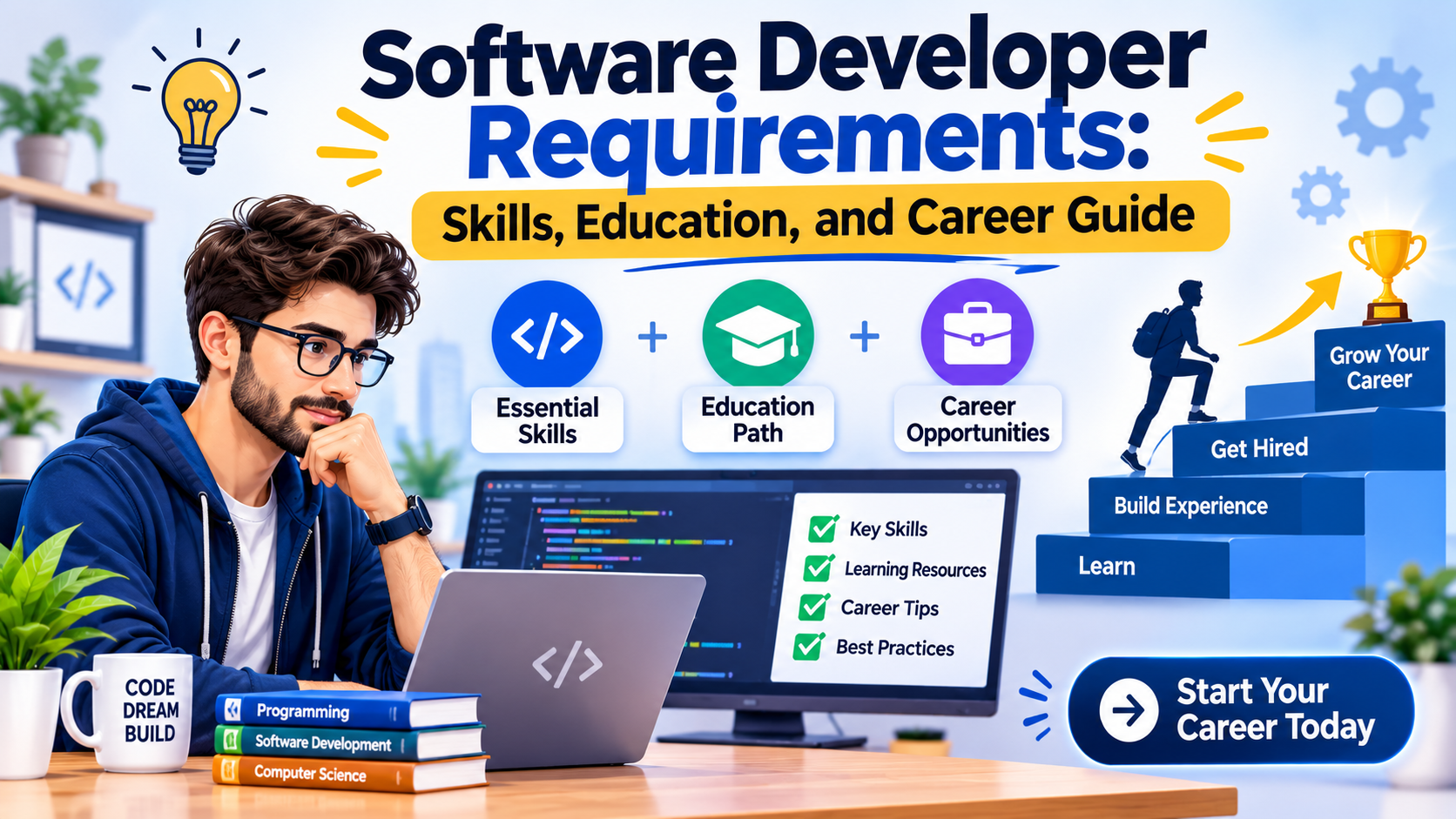
Becoming a software developer requires more than knowing how to write code. Employers look for a combination of technical knowledge, problem-solving ability, practical experience, and communication skills. Understanding software developer requirements can help students, career changers, and aspiring programmers prepare for the right opportunities.
The exact qualifications depend on the employer, job level, and type of software being developed. Some companies prefer candidates with a computer science degree, while others consider practical experience, strong portfolios, and relevant certifications. This guide explains common education requirements, essential programming skills, certifications, internships, job responsibilities, and career opportunities so you can plan your next steps.
What Are the Main Software Developer Requirements?
Software developer requirements are the qualifications, technical abilities, and professional skills employers expect from candidates who build, test, maintain, and improve software applications.
Most entry-level positions look for a combination of:
Knowledge of at least one programming language.
Understanding of programming fundamentals and data structures.
Familiarity with databases and software development tools.
Problem-solving and analytical thinking.
Ability to test, debug, and maintain code.
Communication and teamwork skills.
A degree, relevant training, practical experience, or an equivalent demonstration of ability, depending on the employer.
Not every employer requires the same qualifications. A company hiring a front-end developer may prioritise HTML, CSS, and JavaScript, while a back-end position may require knowledge of server-side programming, databases, and APIs.
Software Developer Education Requirements
Education is a common part of the hiring process, but there is no single educational route into software development. Candidates can build the necessary knowledge through university programmes, technical courses, bootcamps, self-study, and practical projects.
Do You Need a Software Developer Degree?
A software developer degree is not always mandatory, but it can provide a strong foundation for a technical career. Many employers prefer applicants with a bachelor's degree in:
Computer Science.
Software Engineering.
Information Technology.
Computer Engineering.
Information Systems.
A related technical discipline.
These programmes usually cover programming, algorithms, databases, operating systems, software design, and computer networks.
A degree can also help candidates qualify for graduate programmes and positions that specify formal academic requirements. However, some employers place greater emphasis on practical skills and demonstrated experience.
Can You Become a Developer Without a Degree?
Yes. It is possible to enter software development without a traditional university degree. A candidate can develop relevant skills through structured online courses, coding bootcamps, independent study, and personal projects.
A strong portfolio can demonstrate practical ability. For example, building a working website, a task management application, or a small database-driven system gives employers something concrete to evaluate.
Candidates without a degree should be prepared to explain how they learned programming, what they have built, and how they approach technical problems.
Essential Technical Skills Every Software Developer Needs
Technical skills vary by specialisation, but several foundations are useful across most software development roles.
1. Programming Languages
Developers need to understand at least one programming language well enough to write, test, and maintain code. Common choices include:
Language | Common uses |
Python | Automation, backend development, data applications, AI |
JavaScript | Interactive websites and web applications |
Java | Enterprise applications and backend systems |
C# | Business software and application development |
C++ | Systems programming, performance-focused applications |
PHP | Server-side web development |
Beginners should focus on understanding programming fundamentals instead of trying to learn every language at once.
2. Data Structures and Algorithms
Data structures organise information, while algorithms describe how problems are solved through a sequence of steps.
Developers should understand concepts such as arrays, lists, stacks, queues, sorting, searching, and basic algorithm efficiency. These topics help programmers write more reliable and efficient software.
3. Databases and SQL
Many applications need to store and retrieve information. Developers should understand how databases work and how to perform basic operations using SQL.
Useful knowledge includes:
Creating and managing database tables.
Writing queries to retrieve information.
Understanding relationships between data.
Using primary and foreign keys.
Applying basic database security principles.
Experience with relational databases such as MySQL or PostgreSQL can be valuable. Some roles also involve document-oriented databases.
4. Version Control and Development Tools
Version control helps developers track changes, collaborate, and manage different versions of a project. Git is widely used, often alongside platforms such as GitHub or GitLab.
Developers should also become comfortable using code editors, debugging tools, package managers, and development environments relevant to their chosen technology.
5. Testing and Debugging
Writing code is only part of the job. Developers must identify errors, test functionality, and make sure applications behave as expected.
Useful concepts include unit testing, integration testing, debugging techniques, and code reviews. Understanding these practices helps prevent small issues from becoming larger problems.
Software Developer Job Description: What Do Developers Do?
A software developer job description generally covers the design, creation, testing, deployment, and maintenance of software applications.
Typical responsibilities include:
Discussing project requirements with clients, managers, or team members.
Planning application features and technical solutions.
Writing clean, maintainable code.
Testing applications and fixing defects.
Reviewing code and collaborating with other developers.
Updating existing software and resolving technical issues.
Documenting important development processes.
Daily responsibilities depend on the role. A front-end developer focuses on the user interface, while a back-end developer works on server-side functionality, databases, and application logic.
Some developers work across both areas as full-stack developers.
Important Soft Skills for Software Developers
Technical ability is essential, but professional skills also influence how effectively developers work with teams and deliver projects.
Important soft skills include:
Problem-solving: Breaking complicated issues into manageable steps.
Communication: Explaining technical ideas clearly to colleagues and clients.
Time management: Organising tasks and meeting project deadlines.
Adaptability: Learning new tools and adjusting to changing requirements.
Attention to detail: Identifying errors and understanding how small changes affect an application.
Teamwork: Collaborating through code reviews, planning sessions, and shared development tasks.
Developers often work with designers, project managers, quality assurance specialists, and business stakeholders. Strong communication helps ensure that the final software meets actual user needs.
Software Developer Certifications That Can Strengthen Your Profile
Software developer certifications can provide structured learning and demonstrate knowledge of particular technologies. They are not a universal requirement, but they may support an application when they match the position.
Relevant options depend on the developer's interests and career direction. Examples include:
Cloud certifications from providers such as AWS or Microsoft.
Java programming certifications.
Database-related certifications.
Professional credentials in specific development platforms.
Training certificates in software testing or secure development.
Before paying for a certification, review job advertisements in your chosen field. If employers repeatedly request a particular technology, training in that area may be more useful than collecting unrelated certificates.
A certificate should support practical ability, not replace it. Candidates should combine formal learning with projects that demonstrate how they apply technical concepts.
How to Get Software Developer Entry Level Jobs
Finding software developer entry level jobs can be challenging because employers often prefer candidates who can contribute to real projects. Building practical experience before applying can make the transition easier.
Step 1: Choose a Development Specialisation
Start by exploring different areas of software development:
Front-end development.
Back-end development.
Full-stack development.
Mobile application development.
Desktop software development.
Cloud and DevOps-related development.
Choose one direction initially so you can focus your learning.
Step 2: Build Practical Projects
Create projects that demonstrate your skills. Good beginner examples include:
A responsive personal portfolio website.
A task management application.
A simple ecommerce storefront.
A weather application using an API.
A basic inventory management system.
Explain what each project does, which technologies you used, and what challenges you solved.
Step 3: Create a Professional Portfolio
A portfolio gives recruiters and hiring managers a way to review your work. Include links to working projects, source code where appropriate, and short descriptions of your contributions.
For web developers, understanding how websites are planned and built is particularly useful. This custom web design guide provides additional context about website structure and user-focused design.
Step 4: Apply for Internships and Junior Positions
A software developer internship can provide valuable experience working on real projects under the guidance of experienced developers.
Search for internships, graduate programmes, junior developer positions, and trainee opportunities. A software developer intern may help with testing, documentation, bug fixes, and smaller development tasks before taking on more complex responsibilities.
Step 5: Prepare for Technical Interviews
Technical interviews may include programming exercises, problem-solving questions, project discussions, and questions about software development concepts.
Practise explaining your approach instead of focusing only on reaching the final answer. Employers may want to understand how you identify problems, evaluate possible solutions, and communicate your reasoning.
Finding Software Developer Jobs Near Me or Remote Opportunities
Candidates can search for software developer jobs near me through job boards, company career pages, professional networks, and local technology communities.
Useful search methods include:
Searching job platforms by city and job title.
Checking local software companies and technology agencies.
Connecting with recruiters and developers.
Attending coding events and professional meetups.
Following companies that regularly hire junior developers.
Remote opportunities can expand the range of available positions. Searches for software developer jobs remote may reveal companies hiring across different locations, although eligibility depends on the employer's location, employment policies, and time-zone requirements.
When reviewing a remote position, check whether the company offers full-time employment, contract work, or freelance arrangements. Also review communication expectations, working hours, equipment requirements, and payment terms.
Software Developer Salary: What Influences Earnings?
A software developer salary depends on several factors, including location, experience, specialisation, technical skills, industry, and employer size. There is no single salary that applies to every developer.
Common factors affecting compensation include:
Factor | Potential influence |
Experience | Senior developers may qualify for higher-level positions |
Location | Pay varies between countries, cities, and labour markets |
Specialisation | Demand differs across development fields |
Technical skills | Relevant expertise can improve job opportunities |
Industry | Employers in different sectors offer different compensation |
Employment type | Salaries and benefits vary between permanent and contract roles |
Candidates should compare salaries using current job advertisements and reliable local salary data. They should also consider benefits, professional development, flexibility, and career progression rather than evaluating an offer on base pay alone.
Software Developer vs Software Engineer: What Is the Difference?
The terms software developer and software engineer are sometimes used interchangeably, but their emphasis can differ depending on the organisation.
Software Developer | Software Engineer |
Often focuses on building and maintaining applications | May focus on broader software systems and engineering processes |
Works on features, functionality, and code implementation | May emphasise architecture, scalability, reliability, and system design |
Collaborates with designers, testers, and other developers | May work across larger technical teams and system components |
Responsibilities depend on the specific job | Responsibilities also depend on the employer and project |
There is no universal distinction across all companies. Some organisations use the titles for nearly identical roles. Candidates should read the actual responsibilities and qualifications in each job advertisement rather than relying only on the job title.
Common Mistakes to Avoid When Starting a Software Development Career
New developers can improve their progress by avoiding a few common mistakes:
Learning too many languages at once: Build a solid foundation in one language before expanding.
Ignoring practical projects: Employers need evidence that you can apply what you have learned.
Skipping fundamental concepts: Data structures, algorithms, databases, and debugging are useful across many roles.
Relying only on certificates: Demonstrable skills and project experience matter.
Not reading job descriptions carefully: Requirements vary by specialisation and employer.
Avoiding collaboration: Software development often involves shared codebases and team-based problem-solving.
A consistent learning routine and regular project work are generally more productive than trying to master everything at once.
Conclusion
Understanding software developer requirements helps aspiring programmers choose the right education, develop relevant technical skills, and prepare for employment opportunities. A degree can provide a useful foundation, but practical projects, programming knowledge, problem-solving, and professional communication also play important roles.
Start by selecting a development specialisation, learning the tools used in that field, and building projects that demonstrate your abilities. Then explore internships, entry-level positions, and remote opportunities that match your current experience. With a clear learning plan and consistent practice, you can build a strong foundation for a software development career.
6. FAQs
1. What qualifications do you need to become a software developer?
Many employers prefer a degree in computer science, software engineering, or a related subject. However, some accept candidates with relevant training, practical experience, programming knowledge, and a strong project portfolio.
2. Can I become a software developer without a degree?
Yes. You can learn programming through online courses, bootcamps, self-study, and practical projects. A portfolio demonstrating your technical skills can help support your job applications.
3. Which programming languages should a beginner learn?
Python and JavaScript are common starting choices. Python is used in automation, backend development, and data applications, while JavaScript is widely used for interactive websites and web applications.
4. Are software developer certifications necessary?
No. Certifications are not mandatory for every software development role. However, relevant credentials can demonstrate knowledge of specific technologies and support your professional development.
5. How can I get my first software developer job?
Learn programming fundamentals, build practical projects, create a portfolio, practice technical interviews, and apply for internships or junior developer positions. Tailor your applications to the technologies listed in each job description.
6. Is software development a good career for beginners?
It can be a suitable career for people who enjoy problem-solving, logical thinking, and continuous learning. Beginners should understand that developing professional skills takes time and consistent practice.
7. Can software developers work remotely?
Yes. Many companies offer remote software development positions. Availability depends on the employer, location, experience requirements, employment arrangements, and technical needs.
8. What is the difference between a software developer and a software engineer?
The titles can overlap. Developers often focus on building and maintaining applications, while software engineers may have broader responsibilities involving architecture and system design. Actual duties vary by company.
Have a question or a different perspective? Share it below.